29 maja 2026 | online
Link do konferencji
https://teams.microsoft.com/meet/36412416182446?p=Ky2XrOl7ZNxZ42xcQc
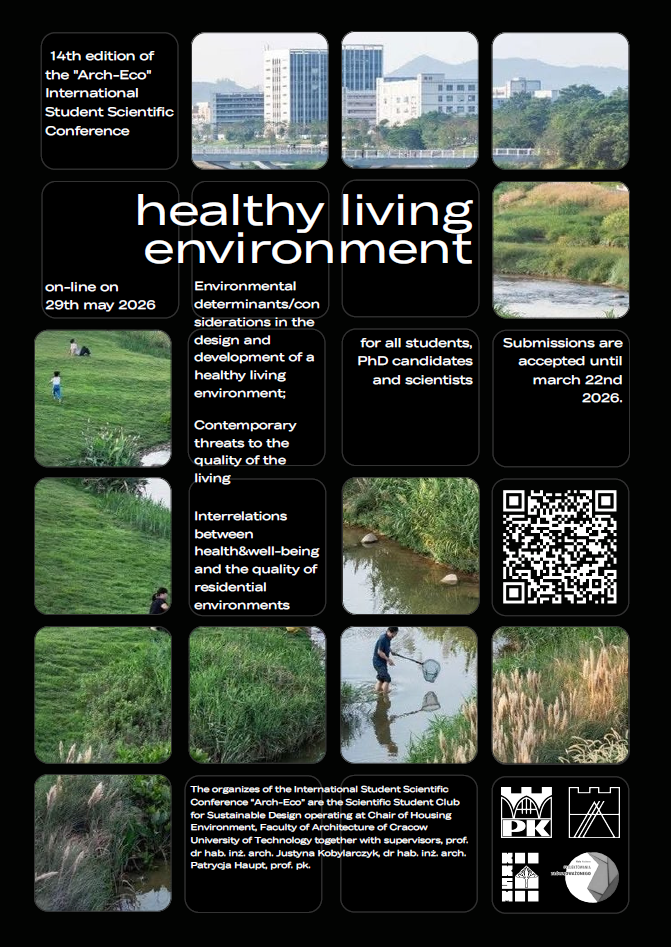
Koło Naukowe Projektowania Zrównoważonego działające przy Katedrze Środowiska Mieszkaniowego Wydziału Architektury Politechniki Krakowskiej serdecznie zaprasza do udziału w XIV Międzynarodowej Konferencji Naukowej ARCH-ECO 2026 „Healthy Living Environment”, która odbędzie się w formule online dnia 29 maja 2026 roku.
Konferencja poświęcona jest problematyce kształtowania zdrowego środowiska zamieszkania, współczesnym zagrożeniom dla jakości przestrzeni mieszkaniowej oraz rozwiązaniom wspierającym zdrowie, dobrostan i komfort użytkowników. Wydarzenie gromadzi studentów, doktorantów, naukowców oraz praktyków z Polski i zagranicy, tworząc przestrzeń do wymiany doświadczeń i prezentacji badań dotyczących współczesnych wyzwań architektury, urbanistyki i projektowania środowiska mieszkaniowego.
Organizatorami konferencji są Koło Naukowe Projektowania Zrównoważonego wraz z opiekunami naukowymi: prof. dr hab. inż. arch. Justyną Kobylarczyk oraz dr hab. inż. arch. Patrycją Haupt, prof. PK.
Program konferencji: https://zrownowazeni.pk.edu.pl/wp-content/uploads/2026/05/CONFERENCE-PROGRAM-Archeco-2026_link.pdf
Uroczyste otwarcie
09:40–10:00 https://teams.microsoft.com/meet/36412416182446?p=Ky2XrOl7ZNxZ42xcQc
XIV International Scientific Conference ARCH-ECO 2026 “Healthy Living Environment”
29 May 2026 | online
Conference link
https://teams.microsoft.com/meet/36412416182446?p=Ky2XrOl7ZNxZ42xcQc
The Student Scientific Association of Sustainable Design operating at the Chair of Housing Environment, Faculty of Architecture, Cracow University of Technology, cordially invites students, PhD candidates, researchers, and professionals to participate in the XIV International Scientific Conference ARCH-ECO 2026 “Healthy Living Environment”, which will be held online on 29 May 2026.
The conference focuses on issues related to healthy living environments, contemporary threats to the quality of residential spaces, and solutions supporting health, well-being, sustainability, and user comfort. The event provides an international platform for the exchange of research, experiences, and innovative ideas concerning architecture, urban design, and housing environments.
The conference is organized by the Student Scientific Association of Sustainable Design together with the academic supervisors: prof. Justyna Kobylarczyk and dr hab. Patrycja Haupt, prof. CUT.
Conference themes
Session I – Environmental determinants in shaping healthy residential areas
This session focuses on environmental determinants shaping healthy residential areas, including green infrastructure, climate adaptation, biophilic design, the quality of public spaces, and the impact of environmental conditions on residents’ health.
Session II – Contemporary threats to a high-quality residential environment
The session addresses contemporary threats affecting the quality of residential environments, such as suburbanization, light pollution, sick building syndrome, over-urbanization, and the impact of technological infrastructure and data-related facilities on living spaces.
Session III – Health-promoting determinants and the quality of residential areas
This session is dedicated to factors supporting residents’ health and well-being, including intergenerational housing, natural materials, quiet urban spaces, smart ecology, and the relationship between housing quality and physical and mental health.
Conference programme
Welcome ceremony
09:40–10:00
Scientific sessions
10:00–15:30
The conference programme includes three international scientific sessions, presentations by participants from Poland, Ukraine, Kazakhstan, Latvia, Italy, Spain, and Turkey, as well as discussion panels summarizing each thematic block.
Topics presented during the conference include:
- climate adaptation in cities,
- biophilic and therapeutic design,
- mental health in residential environments,
- inclusive design,
- circular and modular architecture,
- light pollution and overheating in buildings,
- active mobility and residents’ well-being,
- green infrastructure and biodiversity,
- contemporary urbanization challenges and the quality of living environments.